
Advice

Cat Missing Overnight: When Should You Worry?

It is late, the bowl is untouched, and the call that always brings him in has brought in nothing. For many outdoor cat owners there comes an evening like this, when the normal routine suddenly changes.

The honest answer to "should I worry?" is: it depends on him. Cats are individuals with routines, and the routine is your best guide. A cat who often rolls in at midnight is probably fine. A cat who has come home for dinner at six every day for four years and suddenly has not is telling you something.

In short

  • Judge the delay against his normal pattern, not the clock.
  • An unusual late night does not automatically mean trouble. Some cats return on their own later that night or by morning.
  • Do a calm search of nearby closed spaces before bed rather than waiting until morning.
  • If he is still missing next day, search seriously and start close to home. Many located cats are found near where they went missing.

Never want another night like this? See the petTracer recovery system →

Is it normal for a cat to stay out all night?

For some cats, yes, occasionally. A warm evening, something worth stalking two gardens over, a territory dispute running late. Unneutered cats are known to roam further afield, and some cats simply keep summer hours.

What matters is the word occasionally. You know his pattern better than anyone. When tonight is genuinely unlike him, trust that instinct over any general rule about how long to wait.

What should you do before going to bed?

Twenty minutes of calm, methodical effort beats hours of anxious pacing. Before you turn in:

  • Walk the garden and the immediate street with a torch, slowly, pausing to listen.
  • Check your own shed, garage and any outbuilding, properly, behind things.
  • Ask any neighbours still awake to physically check their sheds, garages and outbuildings, especially anyone who closed one up this evening.
  • If safe and practical, keep his normal route home available. A cat flap is ideal; avoid leaving doors or ground-floor windows unsecured overnight.
  • Torchlight helps: eyes reflect, and a cat who will not answer may still be seen.

Then, genuinely, try to sleep if you can. Some cats stroll back at breakfast wondering what all the fuss was about; if he is not back by morning, you will want the energy.

Should I stay up all night looking for my missing cat?

Not necessarily, and there is no single right answer. If the absence is unusual, do the calm local search that evening. Once you have checked the house, the garden and the likely enclosed spaces, rest and a proper search at first light may serve you better.

The exceptions are specific: he never normally stays out, the weather has turned foul, there were fireworks or another disturbance, tracking information points somewhere concrete, or you have real reason to think he is trapped or injured. If you genuinely believe he is in immediate danger, keep looking rather than waiting for daylight.

Should I wait until morning to search?

No. If his absence is unusual, there is no need to wait until morning for a calm local check. The house, the garden and the nearest enclosed spaces can all be checked the same evening, and a torch genuinely helps: eyes reflect.

If he is still missing in the morning, move from checking to searching: widen the area systematically, involve more neighbours, and keep re-checking enclosed spaces daily.

When does a late night become a missing cat?

If he is still not home by the following morning, stop waiting and start searching properly. The first day matters.

Many missing cats are found relatively close to where they disappeared, although cats with regular outdoor access can travel considerably farther. The numbers come from research rather than folklore: a 2018 study of 1,210 lost cats found that 75% of located cats were within 500 metres of where they went missing, that roughly a third of the cats were found alive within the first 7 days, and that thorough physical searching was a useful strategy. One everyday explanation is worth ruling out early: he may have been accidentally shut inside a shed, garage or neighbouring outbuilding, and a frightened or trapped cat may stay silent even when you are close and calling.

So search close, low and behind things. Ask neighbours to physically check their sheds, garages and other enclosed spaces, and repeat the checks daily, because those doors open and close all the time.

The difference preparation makes at midnight

petTracer is a cat recovery system built for exactly this evening. Instead of standing in the dark wondering which direction to even face, GPS shows the collar's last recorded position while it has satellite reception. If he is close but hidden, the HomeStation reads the collar's radio signal strength as you move, stronger as you get closer, and radio can work through walls and in places where GPS reception is weak. The worry does not vanish, but it finally has somewhere useful to go.

Step 1

GPS finds the area

Outdoors, GPS shows you roughly where he is, so the search starts in the right place.

Step 2

Radio closes the distance

At close range, you follow the collar's radio signal strength to home in on him. Radio can work through walls.

Step 3

The app and HomeStation

The HomeStation charges the collar and doubles as a hand-held direction finder.

"Now we know exactly what her territory is. She's living her best life, knowing she can come back home whenever she wants. And we no longer have to worry about where she is. Thanks to the collar."

Martha's owner, after five weeks missing · read the full story

petTracer collar with HomeStation

petTracer recovery system

Built to recover missing cats, not just track them.

  • Ultralight 34 g collar, designed exclusively for cats
  • GPS to establish the search area outdoors
  • Close-range radio search that can work through walls
  • Up to 7 days of battery in normal use, around 30 in Eco mode
  • Swiss engineered, with 30 days to try it
See the petTracer recovery system

Swiss Made · 30-day returns

Make the next late night a different experience

You cannot stop a cat being a cat, and you would not want to. Roaming, patrolling, disappearing on mysterious business: that is the animal you signed up for.

What you can change is what midnight feels like. With a 34 g collar and up to 7 days of battery in normal use, petTracer is designed to be worn through every ordinary day. Worn every day. Built for the one night he does not come home.

Make the next late night just a late night.

The petTracer recovery system: GPS to find the area, radio to find the cat.

See the petTracer recovery system

30 days to try it · Free UK delivery · Swiss Made

Common questions

How long should I wait before searching for my cat?

Do a calm local check the same evening he fails to show. If he is still missing the next morning, begin a proper search of nearby enclosed spaces and ask neighbours to open theirs.

Where do cats go overnight?

He may be within his normal territory, roaming farther than usual, sheltering somewhere, or accidentally shut inside an enclosed space. Research shows many missing cats are eventually found relatively close to where they disappeared, but cats with regular outdoor access can travel farther.

Should I leave food out for a missing cat?

Leave his usual bowl by the door he uses, so home smells and looks normal if he returns overnight. Check it in the morning for signs of a visit.

Will he come back on his own?

He may. Some cats return on their own, but do not rely on that if the absence is genuinely out of character. A cat who is trapped or injured may be unable to return, which is why nearby enclosed spaces are worth checking early.

Should I leave the cat flap open for a missing cat?

If it is safe and practical, yes. Keeping his normal route home available means he can let himself in without anyone waiting up, and a microchip-reading cat flap keeps other animals out. Avoid leaving doors or ground-floor windows unsecured overnight for the same reason.


Share

Related articles

  • Cat Trapped in a Shed or Garage? How to Find HimAdvice
    Cat Trapped in a Shed or Garage? How to Find Him
    If a normally reliable cat suddenly fails to come home, one possibility worth checking quickly is that he has been accidentally shut inside a nearby shed, garage or other enclosed space. Sheds, garages, outbuildings, cellars, greenhouses. Cats slip into them while a door stands open, settle somewhere comfortable, and are still inside when the door shuts. It happens more often than most owners realise, and it is one of the most fixable ways for a cat to go missing, if you search the right way. In short Cats can get shut in sheds, garages and other enclosed spaces without anyone realising. A frightened or trapped cat may stay completely silent, even when he hears you calling. GPS can show the area, but signals weaken inside buildings, so it rarely tells you which door he is behind. Radio direction finding can work through walls, which is why petTracer uses it for close-range search. See how petTracer helps find cats where GPS isn't enough → Why do cats get shut in so often? Sheds and garages are quiet, sheltered and full of hiding places, which makes them interesting to a curious cat. He wanders in while the door stands open, finds a corner, and stays longer than he meant to. Then someone locks up for the evening without realising a cat is inside. Nobody has done anything wrong, and he may not be discovered until the next time that door happens to be opened. Why doesn't he meow when you call? It feels like it should be simple: you call, he answers, done. In reality, a frightened or trapped cat may make no sound at all, even with his owner's voice a few metres away. Staying quiet and still is a common response when something feels wrong. The practical lesson matters more than the explanation: do not assume a shed or garage is empty just because your cat does not answer. You can call at the right door, hear nothing, and cross it off the list while he sits inside. Close does not mean found. Can GPS find a cat inside a garage? Not reliably on its own. GPS works best outdoors with a clear view of the sky. Buildings, walls and other obstructions can weaken or block satellite reception, and if a cat goes inside a garage, shed or house, new GPS positions may stop coming through altogether. That has an important consequence: the last position you see may be the last place the collar had decent satellite reception, rather than where he is right now, and accuracy can also degrade around buildings. GPS brings you to the right part of the neighbourhood. From there, a different tool has to take over. How petTracer finds a cat behind a closed door petTracer is a cat recovery system that combines GPS with radio tracking. GPS records his location while satellite reception is available outdoors. If GPS is lost but the collar is still within radio range, you can take the HomeStation with you and compare the collar's radio signal strength as you move: stronger means closer, weaker means further away. Used like a radar, it narrows the search down to the shed, garage or cellar he is actually in, and the radio signal can work through walls. Step 1 GPS finds the area Outdoors, GPS shows you roughly where he is, so the search starts in the right place. Step 2 Radio closes the distance At close range, you follow the collar's radio signal strength to home in on him. Radio can work through walls. Step 3 The app and HomeStation The HomeStation charges the collar and doubles as a hand-held direction finder. How do I know if my cat might be trapped nearby? With petTracer specifically, there is a useful clue: if there is no current GPS position but the collar is still in radio contact with the HomeStation, that suggests he is within radio range but somewhere with poor satellite reception. That could mean inside a building, underneath a car, beneath dense cover, or another spot the sky cannot reach. Treat it as a clue rather than proof. What it tells you is to slow down and search the enclosed spaces nearby before widening the search. "With petTracer, there's no fuss. She wears it comfortably, and I know I'll have a real chance of finding her if she ever disappears again. The radio signal even works when GPS can't, like if she's trapped indoors again." Floofs' owner, after seven weeks missing · read the full story petTracer recovery system Built to recover missing cats, not just track them. Ultralight 34 g collar, designed exclusively for cats GPS to establish the search area outdoors Close-range radio search that can work through walls Up to 7 days of battery in normal use, around 30 in Eco mode Swiss engineered, with 30 days to try it See the petTracer recovery systemSwiss Made · 30-day returns How to search for a cat trapped nearby The research backs the close-first approach. A 2018 study of 1,210 missing cats found that 75% of located cats were within 500 metres of where they went missing, and among cats found alive with a recorded distance, the median was just 50 metres. Whether or not he wears a tracker, the method matters: Start close to where he went missing, checking neighbouring sheds, garages and enclosed spaces first, then widen the search if needed. Ask neighbours directly to open sheds, garages, cellars and greenhouses. Do not settle for "I'll keep an eye out". Search in the quiet of late evening or early morning, and pause to listen after calling. Look low and behind: under decking, behind stacked wood, inside anything with a gap. Repeat every day. People open and shut these doors constantly, and a shed that was checked on Tuesday can trap him on Wednesday. The bottom line A cat missing near home may simply be behind a door, waiting. The map gets you close. Opening the right door gets him home. petTracer exists for exactly this gap between the two: GPS for the area, radio for the door. Never search door to door blind again. The petTracer recovery system: GPS to find the area, radio to find the cat. See the petTracer recovery system30 days to try it · Free UK delivery · Swiss Made Common questions What should I do if I think my cat is trapped in a shed or garage?Act quickly. Ask neighbours to physically open and check sheds, garages and other enclosed spaces rather than calling from outside, because a frightened cat may stay silent. Repeat the checks over the following days, since doors keep being opened and closed. Can a cat tracker work through walls?GPS struggles inside buildings, but radio signals can pass through walls. petTracer uses radio direction finding at close range for precisely this reason. My cat came home after days away. Was he trapped?It is possible, but his condition alone cannot tell you. He may have been shut in, hiding, roaming or unable to get back. If he disappears again, checking nearby enclosed spaces early is still a sensible first step. Should I still knock on doors if he has a tracker?Yes. The tracker directs the search, but a closed shed still needs its owner to unlock it. The technology and the neighbours work together. Sources Huang et al., Animals (2018): Search Methods Used to Locate Missing Cats and Locations Where Missing Cats Are Found PetTracer product page
  • Can You Track a Cat With a Microchip?Advice
    Can You Track a Cat With a Microchip?
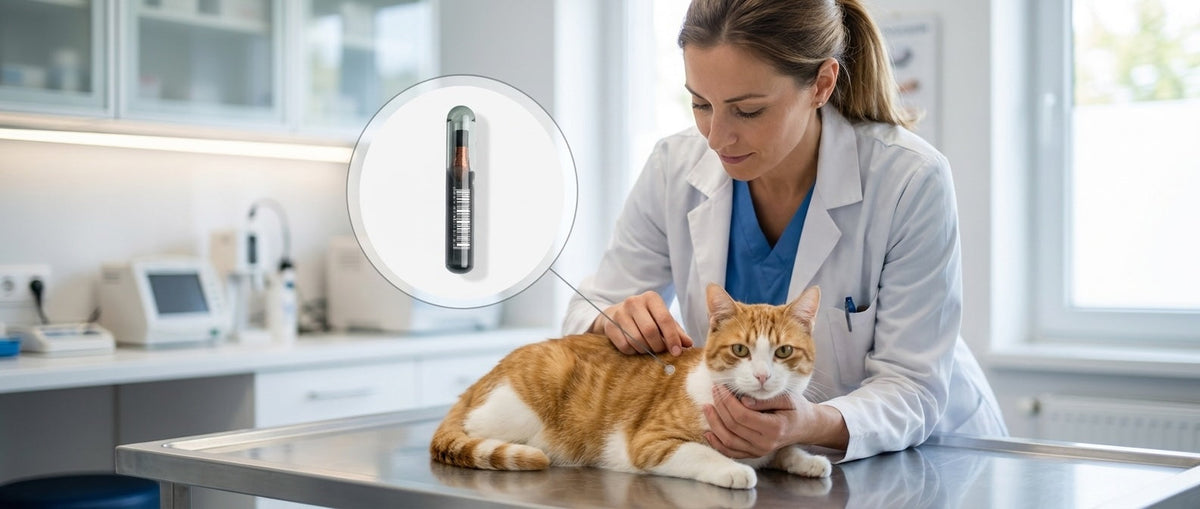
    No, you cannot track a cat with a microchip. It is one of the most common misunderstandings in cat ownership, and it costs owners precious time when a cat goes missing. A standard pet microchip is an identification device, not a GPS tracker. It carries a unique number that a compatible scanner can read once your cat is physically found, linking him back to your contact details on a database. It contains no GPS and does not transmit his location. In short A microchip has no battery, no GPS and no signal. It cannot be tracked. It stores an ID number that a vet or rescue centre can read with a scanner. It works after your cat has been found, not while you are looking for him. To actively track a cat's location, he needs a separate powered device, normally worn on the collar. Want him findable as well as identifiable? See the petTracer recovery system → What does a cat microchip actually do? A microchip is a tiny passive implant, about the size of a grain of rice, placed under the skin between the shoulder blades. It holds one thing: a unique ID number. When a found cat is taken to a vet or shelter, they scan him, look the number up on a database, and ring the owner. That is the entire system, and within its limits it works well. But notice the order of events. Someone has to find him, catch him and take him to be scanned. The chip contributes nothing to the search itself. Can a microchip help find a missing cat? Yes, but only indirectly. If somebody finds your cat and takes him to a vet or rescue centre, the chip is how he gets identified and returned to you. What it cannot do is show you where he is: there is no live position, no GPS, nothing to follow. In other words, a microchip supports the reunion, not the search. It is no substitute for actively looking for him. Why does the misunderstanding cost so much time? Because it can encourage waiting. An owner who believes the chip itself can be traced may sit tight for a day or two, expecting a phone call. But a microchip only helps once somebody has physically found the cat and had the chip scanned, so that call depends entirely on someone else finding him first. The research points towards searching instead. A 2018 study of 1,210 missing cats (Huang et al., published in the journal Animals) found that 75% of located cats were within 500 metres of where they went missing, and among cats found alive with a recorded distance, the median was just 50 metres. Indoor-only cats tended to be found closer than cats used to roaming unsupervised, and the study concluded that thorough physical searching, particularly within the first week, was a useful strategy. A missing cat may be hiding nearby, or may have been accidentally shut inside a shed, garage or neighbouring building, so checking those places early is well worth it. The early days are when a methodical local search does the most good, and delaying it while hoping for a phone call gives them away. Do cats need both a microchip and a tracker? Yes, ideally, because they solve different problems. The chip identifies him after he is found. A tracker gives you information you can act on while he is missing. The microchip is permanent and works even if he loses his collar. In England, pet cats must be microchipped and registered on an approved database by 20 weeks old; in Scotland, Wales and Northern Ireland it is currently voluntary, though widely recommended. Wherever you live, keep the registration details current. The chip stays readable either way, but out-of-date contact details can make reuniting you with him much slower. A tracking collar is what lets you do something while he is missing. petTracer is a cat recovery system: GPS shows the area he is in outdoors, and at close range the HomeStation reads the collar's radio signal strength, so you can tell whether you are getting closer or further away, even when he is inside a building and staying silent. How do you actually find a microchipped cat? You search for him, and the right tools give the search a direction. petTracer's collar weighs 34 g and combines GPS with radio. GPS narrows things down to a search area. The HomeStation then doubles as a hand-held finder that reads the collar's radio signal strength, growing stronger as you close in on him. Step 1 GPS finds the area Outdoors, GPS shows you roughly where he is, so the search starts in the right place. Step 2 Radio closes the distance At close range, you follow the collar's radio signal strength to home in on him. Radio can work through walls. Step 3 The app and HomeStation The HomeStation charges the collar and doubles as a hand-held direction finder. "Now we know exactly what her territory is. She's living her best life, knowing she can come back home whenever she wants. And we no longer have to worry about where she is. Thanks to the collar." Martha's owner, after five weeks missing · read the full story petTracer recovery system Built to recover missing cats, not just track them. Ultralight 34 g collar, designed exclusively for cats GPS to establish the search area outdoors Close-range radio search that can work through walls Up to 7 days of battery in normal use, around 30 in Eco mode Swiss engineered, with 30 days to try it See the petTracer recovery systemSwiss Made · 30-day returns Keep the chip. Add the search. Chip him, register it, check the details yearly. None of that changes with a tracker on his collar. Just be clear about what each one does. The chip brings him home if a stranger finds him first. A recovery system means you do not have to wait for a stranger. Identified is good. Findable is better. The petTracer recovery system: GPS to find the area, radio to find the cat. See the petTracer recovery system30 days to try it · Free UK delivery · Swiss Made Common questions Can a vet track my cat's microchip?No. A vet can read the chip's ID number with a scanner when the cat is physically in front of them. The chip cannot transmit anything, so there is nothing to track. Is there a microchip with GPS for cats?No. Standard pet microchips do not contain GPS and cannot provide location tracking. Consumer GPS trackers for cats are separate powered devices, normally worn on the collar. My cat is chipped and missing. What should I do?Start an active physical search: check sheds, garages, outbuildings and hiding places nearby, and ask neighbours to open and check theirs. Report him missing to his microchip database, and contact local vets and rescue centres. Clear notices and local posts help too. How wide to search depends on him: an indoor-only cat is usually found closer to home than a cat used to roaming. Does petTracer replace the microchip?No, it works alongside it. The chip identifies him after he is found. petTracer helps you find him: GPS for the search area, radio direction finding for the final approach. Sources Huang et al., Animals (2018): Search Methods Used to Locate Missing Cats and Locations Where Missing Cats Are Found PetTracer product page
  • GPS Tracker or Cat Recovery System: What's the Difference?Advice
    GPS Tracker or Cat Recovery System: What's the Difference?
    The short answer: a GPS tracker primarily gives you location information. A cat recovery system is designed around the wider process of finding a missing cat, including what happens after you reach the general search area. The distinction sounds subtle until you are relying on one of them to find a cat. So it is worth understanding exactly where one ends and the other begins. In short A GPS tracker answers "roughly where is he?" A recovery system answers "how do I get him back?" The difference shows when he is close, hidden, silent or inside a building. petTracer is a recovery system: GPS outdoors, radio direction finding at close range, collar, HomeStation and app working as one. Prefer to skip the theory? See the petTracer recovery system → What is the difference between a GPS cat tracker and a cat recovery system? A GPS cat tracker primarily tells you where the tracker is, when satellite reception and its communication system are available. A cat recovery system is designed around the wider job of finding a missing cat, including close-range searching for the moments when GPS alone may not be enough. petTracer is an example of the second kind: a 34 g collar that records GPS positions outdoors and communicates directly with its HomeStation by radio, so the search can continue at close range when it needs to. What a GPS tracker does well On an ordinary day a tracker is genuinely reassuring. You open the app, see him mooching around the allotments, and get on with your afternoon. For understanding his territory and habits, it is excellent. It also does the first part of an emergency well: when he fails to come home, it points you at an area instead of leaving you guessing which direction to walk. Nobody should dismiss that. Searching blind is dreadful. Where tracking stops Why isn't a location enough to find a cat? Because knowing he is somewhere within a particular area is not the same as being able to reach him. The area the app shows might genuinely cover four or five gardens. GPS also works best outdoors with satellite reception: if he goes into a shed or garage, new positions may stop arriving, and the last point on the map may mark where reception ended rather than where he is now. And he may not help you: a frightened or stressed cat may hide and stay silent, even when his owner is nearby. You can be ten metres from him and not know it. Tracking is not recovery. The map can take you to the right area; finding him within it is a separate job. What makes a recovery system different? It is designed around the moment that matters most: you, standing in the right area, needing to close the final distance to a cat who is hidden and quiet. petTracer is a cat recovery system that combines GPS tracking outdoors with close-range radio searching. GPS gets you to the area. Then the HomeStation, which charges the collar day to day, becomes a hand-held search device: it reads the collar's radio signal strength as you move, stronger as you get closer, weaker as you drift away, so you can progressively narrow down where he is. Radio can work through walls and in places where GPS reception is poor or unavailable, though like any signal it depends on distance and materials. The whole chain is built for cats specifically: a 34 g collar he can wear every day, up to 7 days of battery in normal use, around 30 in Eco mode, engineered in Switzerland. The recovery, step by step One system, two technologies, each doing the part it is best at. Step 1 GPS finds the area Outdoors, GPS shows you roughly where he is, so the search starts in the right place. Step 2 Radio closes the distance At close range, you follow the collar's radio signal strength to home in on him. Radio can work through walls. Step 3 The app and HomeStation The HomeStation charges the collar and doubles as a hand-held direction finder. "With petTracer, there's no fuss. She wears it comfortably, and I know I'll have a real chance of finding her if she ever disappears again. The radio signal even works when GPS can't, like if she's trapped indoors again." Floofs' owner, after seven weeks missing · read the full story petTracer recovery system Built to recover missing cats, not just track them. Ultralight 34 g collar, designed exclusively for cats GPS to establish the search area outdoors Close-range radio search that can work through walls Up to 7 days of battery in normal use, around 30 in Eco mode Swiss engineered, with 30 days to try it See the petTracer recovery systemSwiss Made · 30-day returns Which one does your cat need? If he stays within sight of the kitchen window, a simple tracker, or nothing at all, may honestly serve. But a cat who regularly roams outdoors lives in a landscape of sheds, garages, hedges and other people's property. If his normal routine suddenly breaks, the difference between information and a method is the difference between knowing he is out there and actually walking towards him. Built to recover missing cats, not just track them. That is the whole idea, in one line. Choose recovery, not just tracking. The petTracer recovery system: GPS to find the area, radio to find the cat. See the petTracer recovery system30 days to try it · Free UK delivery · Swiss Made Common questions Is petTracer a GPS tracker?petTracer includes GPS, but it is designed as a cat recovery system rather than a GPS-only tracker. It combines GPS positioning outdoors with direct radio communication between the collar and HomeStation for close-range searching. What is radio tracking for cats?The collar communicates with the HomeStation by radio. During close-range searching you move around and watch the radio signal strength: stronger means you are closer to the collar, weaker means further away, so you can progressively narrow the search area. Radio can work through walls and where GPS reception is poor, though performance depends on distance and materials. Why does petTracer use both GPS and radio?Because they solve different parts of the search. GPS can establish a wider outdoor search area while satellite reception is available. Radio then helps narrow the location at close range, including in places where GPS reception is poor. Cats are found without either technology every day; combining the two simply covers more of the situations a missing cat can end up in. What is the HomeStation?It is the collar's charging station, and it doubles as the mobile device used for close-range searching, reading the collar's radio signal strength as you move. Sources Huang et al., Animals (2018): Search Methods Used to Locate Missing Cats and Locations Where Missing Cats Are Found PetTracer product page