
 Advice
Cat Trapped in a Shed or Garage? How to Find Him
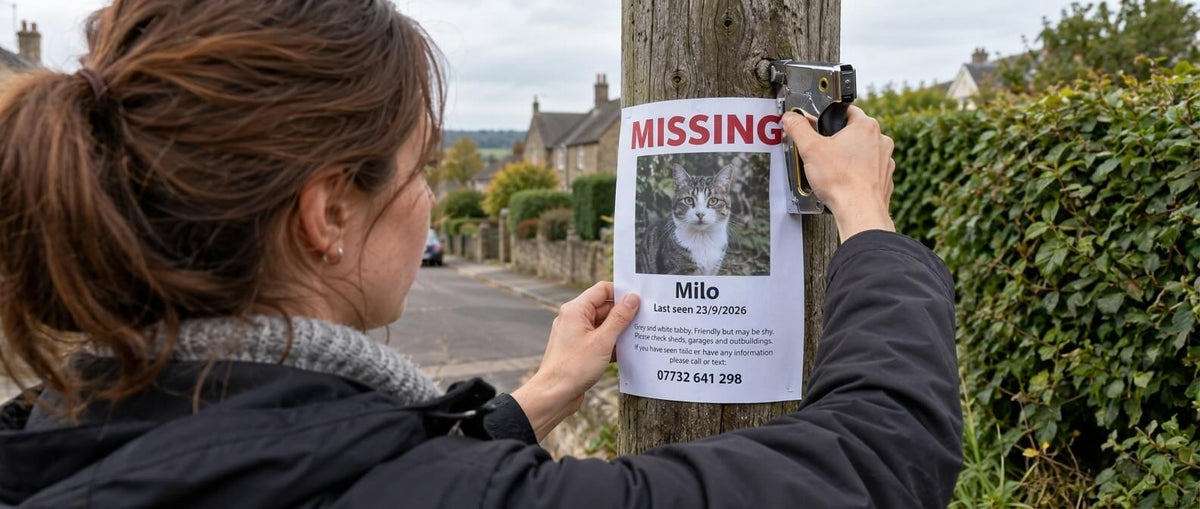
If a normally reliable cat suddenly fails to come home, one possibility worth checking quickly is that he has been accidentally shut inside a nearby shed, garage or other enclosed space.
Sheds, garages, outbuildings, cellars, greenhouses. Cats slip into them while a door stands open, settle somewhere comfortable, and are still inside when the door shuts. It happens more often than most owners realise, and it is one of the most fixable ways for a cat to go missing, if you search the right way.
In short
Cats can get shut in sheds, garages and other enclosed spaces without anyone realising.
A frightened or trapped cat may stay completely silent, even when he hears you calling.
GPS can show the area, but signals weaken inside buildings, so it rarely tells you which door he is behind.
Radio direction finding can work through walls, which is why petTracer uses it for close-range search.
See how petTracer helps find cats where GPS isn't enough →
Why do cats get shut in so often?
Sheds and garages are quiet, sheltered and full of hiding places, which makes them interesting to a curious cat. He wanders in while the door stands open, finds a corner, and stays longer than he meant to.
Then someone locks up for the evening without realising a cat is inside. Nobody has done anything wrong, and he may not be discovered until the next time that door happens to be opened.
Why doesn't he meow when you call?
It feels like it should be simple: you call, he answers, done. In reality, a frightened or trapped cat may make no sound at all, even with his owner's voice a few metres away. Staying quiet and still is a common response when something feels wrong.
The practical lesson matters more than the explanation: do not assume a shed or garage is empty just because your cat does not answer. You can call at the right door, hear nothing, and cross it off the list while he sits inside. Close does not mean found.
Can GPS find a cat inside a garage?
Not reliably on its own. GPS works best outdoors with a clear view of the sky. Buildings, walls and other obstructions can weaken or block satellite reception, and if a cat goes inside a garage, shed or house, new GPS positions may stop coming through altogether.
That has an important consequence: the last position you see may be the last place the collar had decent satellite reception, rather than where he is right now, and accuracy can also degrade around buildings. GPS brings you to the right part of the neighbourhood. From there, a different tool has to take over.
How petTracer finds a cat behind a closed door
petTracer is a cat recovery system that combines GPS with radio tracking. GPS records his location while satellite reception is available outdoors. If GPS is lost but the collar is still within radio range, you can take the HomeStation with you and compare the collar's radio signal strength as you move: stronger means closer, weaker means further away. Used like a radar, it narrows the search down to the shed, garage or cellar he is actually in, and the radio signal can work through walls.
Step 1
GPS finds the area
Outdoors, GPS shows you roughly where he is, so the search starts in the right place.
Step 2
Radio closes the distance
At close range, you follow the collar's radio signal strength to home in on him. Radio can work through walls.
Step 3
The app and HomeStation
The HomeStation charges the collar and doubles as a hand-held direction finder.
How do I know if my cat might be trapped nearby?
With petTracer specifically, there is a useful clue: if there is no current GPS position but the collar is still in radio contact with the HomeStation, that suggests he is within radio range but somewhere with poor satellite reception. That could mean inside a building, underneath a car, beneath dense cover, or another spot the sky cannot reach.
Treat it as a clue rather than proof. What it tells you is to slow down and search the enclosed spaces nearby before widening the search.
"With petTracer, there's no fuss. She wears it comfortably, and I know I'll have a real chance of finding her if she ever disappears again. The radio signal even works when GPS can't, like if she's trapped indoors again."
Floofs' owner, after seven weeks missing · read the full story
petTracer recovery system
Built to recover missing cats, not just track them.
Ultralight 34 g collar, designed exclusively for cats
GPS to establish the search area outdoors
Close-range radio search that can work through walls
Up to 7 days of battery in normal use, around 30 in Eco mode
Swiss engineered, with 30 days to try it
See the petTracer recovery systemSwiss Made · 30-day returns
How to search for a cat trapped nearby
The research backs the close-first approach. A 2018 study of 1,210 missing cats found that 75% of located cats were within 500 metres of where they went missing, and among cats found alive with a recorded distance, the median was just 50 metres. Whether or not he wears a tracker, the method matters:
Start close to where he went missing, checking neighbouring sheds, garages and enclosed spaces first, then widen the search if needed.
Ask neighbours directly to open sheds, garages, cellars and greenhouses. Do not settle for "I'll keep an eye out".
Search in the quiet of late evening or early morning, and pause to listen after calling.
Look low and behind: under decking, behind stacked wood, inside anything with a gap.
Repeat every day. People open and shut these doors constantly, and a shed that was checked on Tuesday can trap him on Wednesday.
The bottom line
A cat missing near home may simply be behind a door, waiting. The map gets you close. Opening the right door gets him home.
petTracer exists for exactly this gap between the two: GPS for the area, radio for the door.
Never search door to door blind again.
The petTracer recovery system: GPS to find the area, radio to find the cat.
See the petTracer recovery system30 days to try it · Free UK delivery · Swiss Made
Common questions
What should I do if I think my cat is trapped in a shed or garage?Act quickly. Ask neighbours to physically open and check sheds, garages and other enclosed spaces rather than calling from outside, because a frightened cat may stay silent. Repeat the checks over the following days, since doors keep being opened and closed.
Can a cat tracker work through walls?GPS struggles inside buildings, but radio signals can pass through walls. petTracer uses radio direction finding at close range for precisely this reason.
My cat came home after days away. Was he trapped?It is possible, but his condition alone cannot tell you. He may have been shut in, hiding, roaming or unable to get back. If he disappears again, checking nearby enclosed spaces early is still a sensible first step.
Should I still knock on doors if he has a tracker?Yes. The tracker directs the search, but a closed shed still needs its owner to unlock it. The technology and the neighbours work together.
Sources
Huang et al., Animals (2018): Search Methods Used to Locate Missing Cats and Locations Where Missing Cats Are Found
PetTracer product page